
How shared containers work
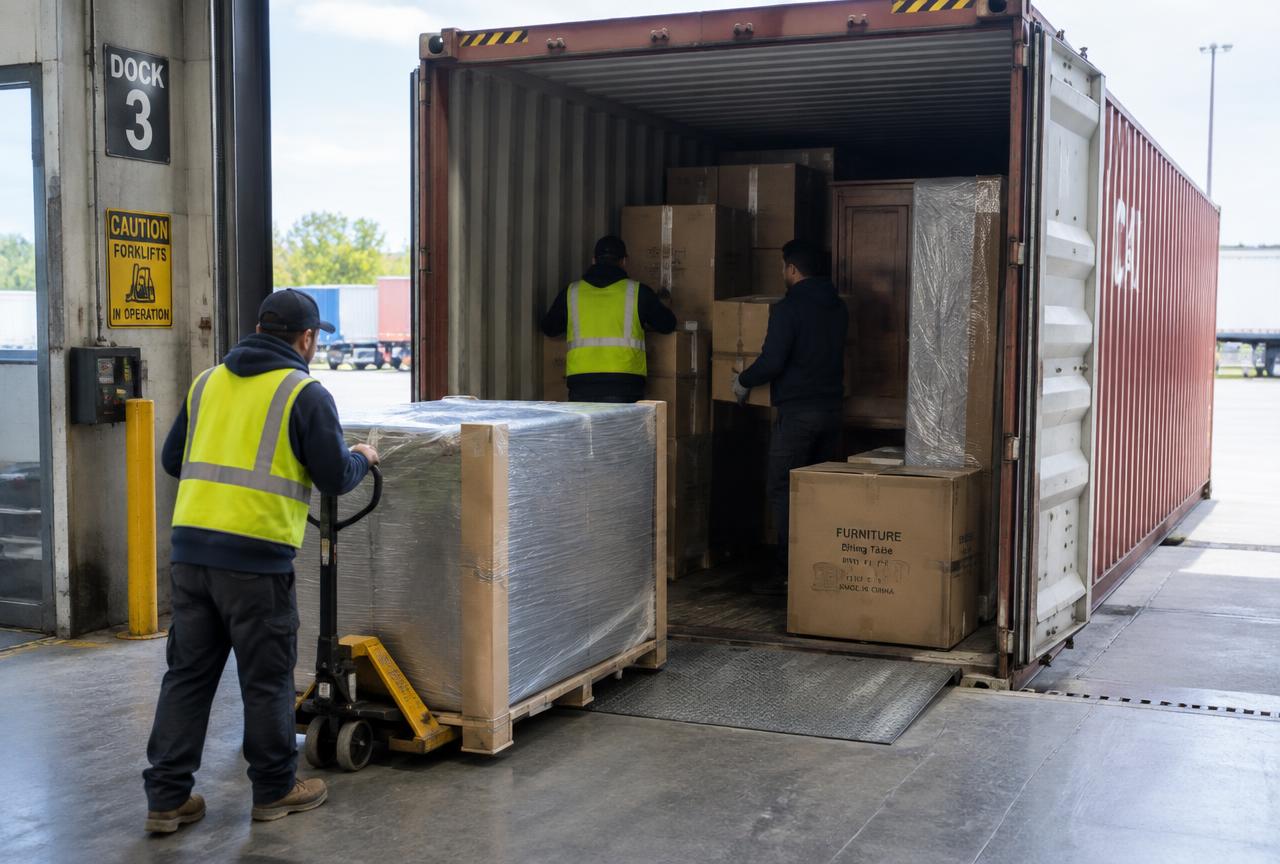
Your goods are received at the China warehouse, measured and recorded against your account. When a container programme is being prepared for your destination, the operations team combines compatible cargo from several customers, plans the loading and books the container. On arrival, the container is unpacked (deconsolidated) and each customer's goods are released separately.
Space-based pricing and weight-or-measure billing
Shared freight is normally charged per cubic metre (CBM). Because some cargo is small but very heavy, carriers and forwarders use a weight-or-measure (W/M) rule: a fixed conversion between weight and volume is applied, and you are charged on whichever is greater. The conversion basis used on your quotation is stated clearly on the quotation itself.
Minimum chargeable volume and other charges
- Most shared-container services apply a minimum chargeable volume per shipment. Any minimum that applies will be shown on your quotation.
- Port, terminal and handling fees apply at origin and destination.
- Warehouse receiving, storage beyond any free period, and repacking may be charged separately.
- Customs duties and taxes are assessed by the destination authority and are not included in freight charges.
- Final delivery from the destination depot to your door is optional and quoted separately.
Advantages
- You do not need enough goods to fill a whole container.
- You can combine purchases from several suppliers into one shipment.
- Your goods are measured and recorded, so you can see what has arrived.
Limitations to consider
- Transit can take longer than a dedicated container because cargo is consolidated and deconsolidated.
- Your goods are handled more often, so good packaging matters.
- Departure depends on the container programme for your destination.
- Whether shared shipping is cheaper than a full container depends on actual freight costs, the volume and the type of cargo. There is no single volume at which one option is always cheaper.
Typical suitable goods
- Boxed furniture
- Household goods and appliances
- Tiles and sanitaryware (subject to weight limits)
- Retail merchandise and clothing
- Tools, hardware and lighting
Why some goods need special arrangements
Hazardous materials, batteries, liquids, very heavy or oversized items, vehicles, and goods needing permits may not be suitable for a shared container, or may need special packing, documentation or a separate shipment. Describe your goods accurately in your quote request so the team can advise.
Worked example
A customer ships 4 cartons of 60 × 50 × 40 cm and a sofa packed at 210 × 95 × 85 cm. Cartons: 60 × 50 × 40 × 4 ÷ 1,000,000 = 0.48 CBM. Sofa: 210 × 95 × 85 ÷ 1,000,000 = 1.696 CBM. Total = 2.176 CBM. The quotation is then prepared on this volume or on the weight equivalent, whichever is greater.